
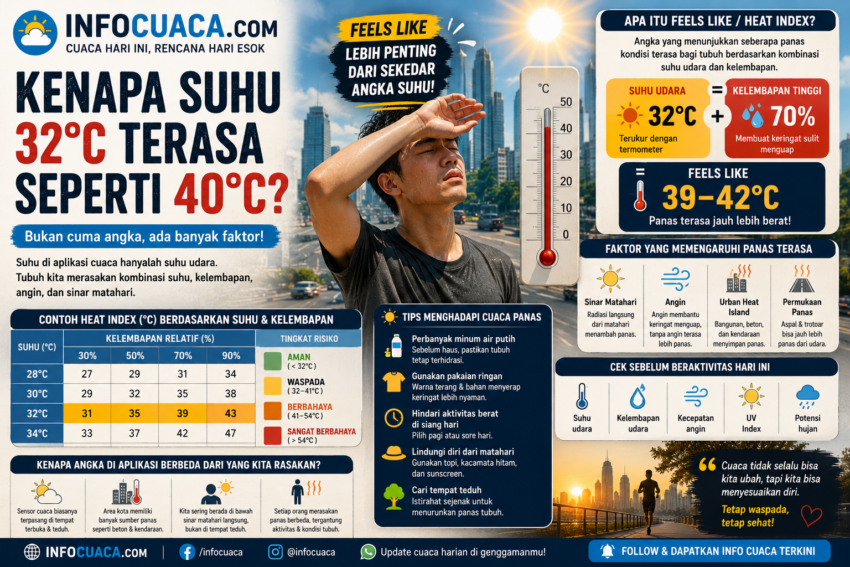
Buka aplikasi cuaca.
Suhu:
32°C.
Kita keluar rumah.
Lima menit kemudian:
“Ini 32°C dari mana? Rasanya 40!”
Baju mulai lengket.
Keringat nggak berhenti.
Udara seperti nggak bergerak.
Matahari terasa menusuk.
Padahal angka di layar tetap:
32°C.
Kenapa bisa begitu?
Karena tubuh manusia tidak hanya merasakan:
temperature.
Kita juga merasakan:
kelembapan,
angin,
radiasi matahari,
permukaan sekitar,
dan seberapa mudah tubuh membuang panas.
Itulah alasan ada angka tambahan seperti:
feels like
atau
apparent temperature.
Suhu Udara Bukan Satu-Satunya Hal yang Dirasakan Tubuh
Thermometer mengukur:
temperature udara.
Tubuh?
Lebih kompleks.
Tubuh berusaha menjaga suhu internal tetap stabil.
Saat panas:
kita berkeringat.
Keringat menguap.
Evaporation membawa panas dari kulit.
Hasilnya:
tubuh terasa lebih dingin.
Masalah muncul ketika udara sudah terlalu lembap.
Kelembapan Membuat Keringat Sulit Menguap
Bayangkan udara seperti spons.
Kalau masih kering:
spons bisa menyerap banyak air.
Kalau sudah jenuh:
sulit menyerap lagi.
Udara dengan humidity tinggi juga memiliki kapasitas lebih kecil untuk menerima tambahan uap air.
Keringat tetap ada di kulit.
Tetapi evaporation melambat.
Akibatnya:
cooling tubuh kurang efektif.
Inilah Kenapa Indonesia Sering Terasa “Lebih Panas”
Indonesia punya kombinasi:
temperature tinggi
humidity tinggi.
Dua hal ini bersama-sama membuat panas terasa jauh lebih berat dibanding angka suhu saja.
32°C di udara kering:
bisa masih cukup tolerable.
32°C dengan humidity sangat tinggi:
beda cerita.
kenapa suhu terasa lebih panas
Salah satu alasan utama kenapa suhu terasa lebih panas adalah karena kelembapan udara tinggi menghambat proses penguapan keringat dari kulit. Tubuh masih menghasilkan keringat, tetapi pendinginan alami menjadi kurang efektif. Selain itu, sinar matahari langsung, minimnya angin, permukaan beton, serta panas dari kendaraan dan bangunan dapat membuat kondisi nyata terasa jauh lebih panas dibanding angka temperature udara yang tercatat.
Jadi angka:
32°C
belum menceritakan seluruh cerita.
Apa Itu Feels Like Temperature?
Feels like temperature adalah estimasi:
seberapa panas atau dingin kondisi terasa bagi tubuh.
Perhitungannya bisa mempertimbangkan:
temperature,
humidity,
wind,
dan dalam beberapa sistem faktor lain.
Untuk panas:
sering berkaitan dengan heat index.
Untuk dingin:
sering berkaitan dengan wind chill.
Heat Index
Heat index mencoba menggabungkan:
air temperature
relative humidity
menjadi satu angka apparent temperature.
Contoh sederhana:
temperature 32°C.
Humidity tinggi.
Heat index mungkin:
38°C,
40°C,
atau lebih.
Bukan berarti thermometer sebenarnya 40°C.
Artinya:
stress panas pada tubuh bisa terasa seperti kondisi yang jauh lebih panas.
cara membaca feels like temperature
Dalam cara membaca feels like temperature, jangan menganggap angka tersebut sebagai suhu udara sebenarnya. Angka “feels like” adalah indikator kenyamanan atau beban panas yang dirasakan tubuh berdasarkan kondisi lingkungan. Jika suhu tercatat 32°C tetapi feels like 39°C, berarti kombinasi kelembapan, angin, dan faktor cuaca lain membuat tubuh mengalami panas yang lebih berat daripada sekadar 32°C.
Untuk aktivitas outdoor:
angka ini sering lebih useful daripada temperature saja.
Relative Humidity Itu Apa?
Relative humidity menunjukkan seberapa dekat udara terhadap kondisi jenuh pada temperature tertentu.
Misalnya:
70%.
Bukan berarti udara terdiri dari 70% air.
Itu misconception.
Artinya udara memiliki sekitar 70% dari jumlah uap air maksimum yang bisa ditampung pada suhu tersebut.
Udara Hangat Bisa Menampung Lebih Banyak Uap Air
Karena capacity berubah dengan temperature:
humidity percentage harus dibaca bersama suhu.
70% humidity pada 20°C:
tidak terasa sama dengan 70% pada 33°C.
Kondisi kedua bisa sangat oppressive.
Dew Point Sering Lebih Berguna
Ada metric lain:
dew point.
Dew point memberi gambaran seberapa banyak moisture sebenarnya di udara.
Semakin tinggi dew point:
udara terasa semakin humid.
Banyak weather enthusiast lebih suka melihat dew point untuk memahami comfort.
Kenapa?
Karena relative humidity berubah ketika temperature berubah.
Dew point lebih langsung menggambarkan moisture content.
Contoh:
morning humidity bisa 90%.
Temperature masih rendah.
Siang:
humidity turun ke 60%.
Apakah moisture hilang drastis?
Belum tentu.
Temperature naik sehingga relative humidity percentage turun.
Pagi Bisa Humid tapi Tidak Terlalu Panas
Jam 6:
26°C.
Humidity 90%.
Masih terasa cukup okay.
Jam 1 siang:
33°C.
Humidity 65%.
Terasa jauh lebih buruk.
Percentage humidity lebih rendah.
Tapi heat load jauh lebih tinggi.
Angin Bisa Mengubah Banyak Hal
Ada angin:
keringat lebih cepat menguap.
Kulit terasa lebih sejuk.
Tidak ada angin:
udara di sekitar kulit stagnan.
Panas terasa lebih berat.
Makanya:
32°C + breeze
bisa terasa jauh lebih nyaman daripada:
31°C + completely still air.
Kipas Angin Bekerja Karena Ini
Kipas tidak benar-benar mendinginkan udara secara signifikan.
Ia menggerakkan udara.
Meningkatkan evaporation dan heat transfer dari tubuh.
Makanya kita merasa lebih sejuk.
Tetapi pada Panas Ekstrem Ada Batas
Kalau temperature udara sangat tinggi:
hembusan udara panas tidak selalu cukup membantu.
Terutama ketika humidity sangat tinggi dan tubuh sulit berkeringat efektif.
Pada kondisi panas ekstrem:
cooling yang lebih efektif mungkin diperlukan.
Sinar Matahari Langsung Bisa Membuat Perbedaan Besar
Weather station biasanya mengukur temperature udara:
di tempat teduh,
dengan standar tertentu.
Kita?
Berdiri langsung di bawah matahari.
Kulit menerima:
solar radiation.
Permukaan jalan juga memantulkan panas.
Akibatnya kondisi yang kita rasakan jauh lebih panas.
Jadi “32°C” Biasanya Bukan Temperature di Atas Aspal
Aspal di bawah matahari bisa memiliki surface temperature jauh lebih tinggi daripada air temperature.
Begitu juga:
atap mobil.
kap mobil.
trotoar.
tembok.
Itulah kenapa area urban bisa terasa brutal.
Urban Heat Island
Kota besar memiliki:
concrete.
asphalt.
buildings.
vehicles.
AC exhaust.
Sedikit vegetation pada beberapa area.
Material tersebut menyerap panas saat siang.
Lalu melepaskannya kembali perlahan.
Akibatnya kota bisa tetap panas bahkan setelah matahari terbenam.
Malam di Kota Bisa Lebih Panas daripada Area Hijau
Desa atau kawasan dengan banyak vegetation:
lebih cepat cooling.
Kota padat:
panas tertahan.
Fenomena ini disebut:
urban heat island.
Pohon Membantu Lebih dari Sekadar Shade
Pohon memberi:
shade
dan
evapotranspiration.
Air dari tanaman menguap dan membantu cooling lokal.
Itulah alasan jalan dengan pepohonan bisa terasa sangat berbeda dibanding jalan beton tanpa shade.
Shade Can Be Huge
Suhu udara sama.
Satu orang berdiri:
di bawah pohon.
Satu lagi:
di tengah lapangan.
Experience totally different.
Radiant heat matters.
Warna Pakaian?
Dark colors menyerap lebih banyak radiation.
Light colors memantulkan lebih banyak.
Tapi pakaian juga dipengaruhi:
material,
fit,
airflow.
Untuk cuaca panas:
breathable fabric + loose fit sering lebih useful daripada hanya warna.
Cotton Selalu Terbaik?
Not always.
Cotton breathable.
Tapi menyerap banyak sweat dan lama kering.
Untuk olahraga:
synthetic moisture-wicking material bisa terasa lebih nyaman.
Context matters.
Linen
Breathable.
Loose.
Good for dry/warm casual conditions.
But wrinkly.
Fashion tax.
Kenapa Keringat Banyak Tapi Nggak Dingin?
Karena sweating sendiri bukan cooling utama.
Evaporation-nya yang mendinginkan.
Kalau keringat hanya menetes:
banyak water loss.
Cooling benefit lebih kecil.
Dehydration Bisa Terjadi Lebih Cepat
Humidity tinggi membuat kita:
berkeringat banyak,
tapi merasa tidak sejuk.
Akibatnya:
fluid loss tinggi.
Ini berbahaya kalau aktivitas outdoor lama.
Jangan Tunggu Haus Parah
Thirst is useful signal.
Tapi saat aktivitas berat/panas:
minum secara teratur lebih baik.
Terutama:
pekerja outdoor,
runner,
cyclist,
traveler.
Electrolyte Perlu Nggak?
Untuk aktivitas harian ringan:
water + normal diet often enough.
Untuk prolonged heavy sweating:
electrolyte replacement bisa membantu.
Tidak perlu minuman olahraga setiap kali keluar rumah 10 menit.
Air Dingin Boleh?
Yes.
Tidak ada masalah umum dengan minum air dingin setelah panas bagi kebanyakan orang.
Pilih temperature yang nyaman.
Hydration matters more.
Jangan Minum Berlebihan Terlalu Cepat
Overhydration juga possible, terutama endurance activity ekstrem.
Balance.
Heat Exhaustion
Paparan panas berlebihan dapat menyebabkan:
pusing.
lemas.
mual.
sakit kepala.
keringat berlebihan.
kulit dingin/lembap.
denyut cepat.
Ini warning.
Heat Stroke Lebih Serius
Heat stroke adalah emergency.
Gejala dapat termasuk:
confusion.
loss of consciousness.
body temperature sangat tinggi.
behavior abnormal.
Perlu pertolongan medis segera.
Jangan Hanya Lihat Temperature untuk Outdoor Activity
Lihat:
feels like.
humidity.
UV index.
wind.
rain chance.
Kalau aktivitas berat:
lebih lengkap.
UV Index Beda dengan Suhu
Mendung?
Masih bisa UV tinggi.
Cool morning?
UV bisa meningkat cepat.
Panas dan UV adalah dua risiko berbeda.
Mendung Tidak Selalu Dingin
Cloud cover bisa mengurangi direct sunlight.
Tapi humidity tinggi + weak wind:
still uncomfortable.
Setelah Hujan Bisa Terasa Lebih Pengap
Hujan berhenti.
Matahari muncul.
Air di tanah menguap.
Humidity naik.
Feels:
sauna.
Common tropical experience.
Hujan Tidak Selalu “Mendinginkan Seharian”
Sometimes short storm gives temporary cooling.
Then humidity makes things sticky again.
Sea Breeze
Kota pantai bisa mendapatkan angin laut.
Ini dapat membantu comfort.
Tapi coastal humidity juga tinggi.
Again:
multiple factors.
Daerah Pegunungan
Temperature lebih rendah karena elevation.
Setiap kenaikan altitude:
air generally cooler.
Exact rate varies.
Itu sebabnya Bandung/Puncak/highlands traditionally terasa lebih sejuk daripada lowland.
Tetapi Kota Pegunungan Juga Bisa Panas Siang Hari
Sun radiation tetap kuat.
Udara mungkin sejuk di shade.
Di bawah direct sun:
hot.
Altitude + UV
Semakin tinggi:
UV exposure bisa meningkat karena atmosphere lebih tipis.
Sejuk tidak berarti sun-safe.
Kenapa Cuaca Panas Sering Terasa Lebih Buruk Jam 2–3 Sore?
Solar noon bukan selalu peak air temperature.
Ground/buildings need time to absorb heat.
Temperature biasanya terus naik setelah matahari mencapai posisi tertinggi.
Ada thermal lag.
Peak Temperature Bisa Terjadi Setelah Tengah Hari
Sering:
early-mid afternoon.
Tergantung weather/local conditions.
Malam Masih Gerah
Because stored heat releases slowly.
Plus humidity can rise after temperature falls.
Comfort may not improve immediately.
Morning Exercise Better?
Sering lebih nyaman karena temperature rendah.
Tapi humidity bisa tinggi.
Still usually less heat load than midday.
Sun exposure lower.
Evening Exercise
Good alternative.
Tapi urban heat may still persist.
Check feels-like.
Noon Exercise
High heat + UV.
Needs more caution.
Especially intense workouts.
Route Matters
Jogging route:
tree-lined park.
vs.
open asphalt.
Same weather app.
Very different body stress.
Timing Is Free Climate Control
Need grocery?
Do early morning or evening.
Simple.
Parking Car Under Sun
Cabin temperature can rise dramatically.
Especially closed windows.
Never leave children or pets unattended in parked vehicles.
Even short periods can be dangerous.
“Open Window Sedikit” Bukan Solusi Aman
Cabin can still heat rapidly.
No compromise here.
Steering Wheel Can Burn
Surface exposed to sun gets extremely hot.
Use shade.
Windshield cover.
Park under shade.
Motorcyclists Feel Different Heat
Moving air helps.
But:
helmet.
jacket.
engine heat.
sun exposure.
stop-and-go traffic.
Can still be intense.
Jangan Lepas Safety Gear Karena Panas
Helmet/jacket matter.
Use ventilated riding gear designed for tropical conditions.
Safety first.
Traffic Jam Is Heat Multiplier
Vehicle heat.
Exhaust.
No wind.
Road radiation.
Sun.
Mental stress.
Everything stacks.
Bus Stop Without Shade
Classic urban design problem.
Shade infrastructure matters for public health.
Architecture Matters
Traditional tropical architecture often uses:
high ceilings.
cross ventilation.
overhangs.
shade.
Modern sealed glass building relies more on AC.
Different strategies.
Cross Ventilation
Openings on opposite sides allow air movement.
Can dramatically improve comfort.
But Outside Air Must Be Better
If outside:
hotter,
smoky,
polluted,
opening windows may not help.
AC Setting
Set absurdly cold?
Energy use increases.
For comfort:
moderate setting + humidity control often enough.
24–26°C Often Feels Comfortable Indoors
Exact preference differs.
Humidity is key.
25°C with low humidity:
comfortable.
25°C with high indoor humidity:
clammy.
Dry Mode AC
Can reduce humidity in appropriate conditions.
Sometimes room feels cooler even without huge temperature drop.
Dehumidifier
In humid climates, useful for certain rooms.
But it produces some heat while operating.
Balance.
Fans + AC
Fan lets occupants feel comfortable at slightly higher thermostat temperature.
Can save energy.
Turn Fan Off When Room Empty?
Fan cools people, not room.
If nobody there:
little reason to run.
Curtains/Blinds
Block solar heat.
Especially west-facing windows.
Afternoon sun brutal.
Roof Insulation
Huge impact in tropical houses.
Roof receives direct solar radiation.
Insulation can reduce indoor heat gain.
Reflective Roof
Lighter/reflective roofing can reduce heat absorption.
Urban design solution.
Vegetation Around House
Trees.
vertical greenery.
shade.
Can improve local microclimate.
Microclimate
Weather app gives city-level condition.
Your street may differ because:
trees.
buildings.
water.
road.
wind channel.
That’s microclimate.
Why Weather App Sometimes Feels “Wrong”
It might not be wrong.
Station is:
10 km away.
At airport.
Open field.
Your location:
dense urban street.
Different environment.
Sensor Placement Matters
Proper air temperature measurement requires:
shade,
ventilation,
standard height,
away from heat sources.
Phone sensor in sun?
Useless for air temperature.
Car Thermometer Can Read High
Parked over hot asphalt.
Engine heat.
Sun.
Outdoor temperature sensor may temporarily show extreme number.
After driving:
reading stabilizes.
Digital Billboard Temperature?
Sometimes badly placed sensor.
Don’t assume scientific quality.
Home Thermometer Placement
Don’t put:
next to window sun.
above TV.
near kitchen.
Need shaded, ventilated spot.
Humidity Sensor Needs Placement Too
Bathroom?
Obviously high.
Kitchen?
Steam.
Choose representative room.
Weather Station Hobby
Personal weather station can reveal:
your local temperature.
humidity.
rainfall.
wind.
Interesting for weather enthusiasts.
But Installation Quality Determines Data
Bad placement = bad data.
Shade Temperature vs Sun Exposure
This should be repeated:
official air temperature is usually shade-based.
Human activity often happens in sun.
That’s why “rasanya lebih panas.”
Mean Radiant Temperature
A more technical concept:
body exchanges heat with surrounding surfaces through radiation.
Hot walls/road/sun increase radiant load.
This is one reason standard air temp alone is incomplete.
Wet-Bulb Temperature
Another advanced metric.
It relates to heat + humidity and evaporative cooling limits.
As wet-bulb rises, body has increasing difficulty cooling through sweat.
Why People Talk About Wet-Bulb in Extreme Heat
Because it relates to physiological limits.
But casual weather users don’t need to obsess over it daily.
Heat index + local guidance is usually more practical.
Heat Advisories
Meteorological/health agencies may issue heat warnings based on local criteria.
Follow official guidance.
Thresholds can vary by region.
Indonesia and Heat Awareness
Indonesia is used to hot weather.
That can create:
“udah biasa.”
But familiarity doesn’t eliminate heat risk.
Especially:
elderly.
children.
outdoor workers.
people with certain health conditions.
Acclimatization
People can adapt somewhat to heat exposure over days/weeks.
Sweating response improves.
But no one becomes immune.
Tourist from Cooler Country
May struggle more initially.
Allow adaptation.
Even Locals Can Struggle During Heatwaves
Because temperature/humidity exceed usual baseline.
Sleep and Heat
Hot bedroom reduces sleep quality.
Body needs to cool for sleep onset.
Fan/AC/ventilation helps.
Nighttime Temperature Is Important
If nights remain hot:
body gets less recovery.
Heatwave health risk increases.
Dark Roofs + Urban Heat = Night Problem
Stored energy released after sunset.
Power Outage During Heat
Can be serious for vulnerable people.
Have backup cooling plan where possible.
Portable Fan
Useful.
Battery-powered.
But again:
extreme heat requires more than air movement.
Cooling Towel
Works through evaporation.
Less effective in extremely humid conditions.
Still can provide some comfort.
Wet Cloth on Neck
Can help cool skin.
Cold Pack
Use wrapped.
Not directly on skin for long.
Shower
Cool/lukewarm shower can reduce heat discomfort.
Ice-cold isn’t necessary.
Why Very Cold Shower Sometimes Feels Weird
Can cause vasoconstriction and discomfort.
Moderate cool water often enough.
Food During Hot Weather
Heavy meals generate more metabolic heat than lighter meals, but difference isn’t huge in everyday context.
Hydration and comfort more important.
Spicy Food in Hot Climate?
Interesting.
Spicy food triggers sweating.
If sweat evaporates:
can aid cooling sensation.
That’s one reason spicy cuisines exist in hot regions among many cultural factors.
But Humid Climate Limits Evaporation
So benefit depends.
Cold Drinks Feel Good but Don’t “Cool the Whole Body” Forever
Temporary comfort.
Hydration + environmental cooling still needed.
Coffee Dehydrates?
Moderate caffeinated drinks still contribute to hydration for habitual consumers.
But water is simplest during heat.
Alcohol
Can worsen dehydration and judgment.
Not ideal during heat exposure.
Salt
Sweat contains sodium.
Normal diet often replaces.
Heavy/prolonged sweating may require more.
Urine Color
Pale yellow can be a rough hydration clue.
Not perfect.
Certain foods/medications alter it.
Body Signals
Dry mouth.
headache.
dizziness.
fatigue.
Need attention.
Heat and Productivity
Cognitive performance can decline when environment too hot.
Focus harder.
Mistakes increase.
This matters for:
office.
factory.
school.
Classroom Heat
Children learn less effectively when uncomfortable.
Ventilation/shade matter.
Work From Home
Hot room?
Laptop heat.
No airflow.
Productivity tanks.
Environmental comfort is work infrastructure.
Electronics Also Hate Heat
Laptop throttles.
Phone dims screen.
Battery degrades faster in high heat.
Phone Overheating in Sun
GPS + camera + charging + direct sun.
Perfect recipe.
Remove from sun.
Stop heavy use.
Don’t Put Overheated Phone in Freezer
Condensation can damage.
Let it cool naturally in shaded area.
Car Dashboard Phone Mount
Direct sun + charging + navigation.
Overheat warning common.
AC vent mount can help, but avoid condensation issues.
Power Bank in Hot Car
Lithium batteries dislike extreme heat.
Don’t leave them baking.
Weather Affects Daily Costs
More AC.
More electricity.
More bottled drinks.
More transportation choices.
Weather is economic too.
Heat Changes Travel Behavior
People avoid midday.
Malls get crowded.
Night activities rise.
Cities adapt socially.
Tropical City Rhythm
Morning markets.
midday rest.
evening activity.
Climate influences culture.
Clothing Traditions Also Reflect Climate
Loose garments.
light fabrics.
head coverings.
Architecture + clothing are climate adaptations.
“Real Feel” Isn’t Universal
Different apps may show different feels-like numbers.
Why?
Different formulas.
Different weather inputs.
Different treatment of sun/wind.
Don’t expect identical.
Heat Index Has Assumptions
Standard heat-index formulas usually assume certain:
shade.
wind.
clothing.
human conditions.
Direct sunlight can make conditions feel hotter.
Therefore Use It as Guidance, Not Exact Personal Sensation
Each person differs.
Age.
activity.
clothing.
health.
acclimatization.
One Person Says “Biasa Aja,” Another Melts
Both can be genuine.
Thermal comfort varies.
Humidity Hair Test
No scientific instrument needed.
Some people’s hair becomes automatic humidity detector.
Free sensor.
Glasses Fogging
Walk from AC room into humid outdoor air.
Condensation forms on cold lenses.
Classic tropical effect.
Why?
Warm moist air hits cool surface.
Water condenses.
Same physics as cold drink sweating.
Morning Dew
At night surfaces cool to dew point.
Water condenses.
That’s why grass wet even without rain.
Dew Point Name Explained
Temperature where air becomes saturated and condensation begins, under appropriate cooling.
Fog
Essentially cloud near ground.
High humidity + cooling.
High Humidity Doesn’t Mean Rain Guaranteed
Air can be humid without enough lift/instability for rain.
Hot Weather Doesn’t Always Mean Sunny
Cloudy + humid can be miserable.
Weather Is Combination, Not Single Number
This is central lesson.
Temperature.
humidity.
wind.
cloud.
sun.
pressure.
rain.
all interact.
Weather App Reading Habit
Instead of only:
“32°C.”
Look at:
feels like.
humidity.
rain.
UV.
wind.
Now picture more complete.
For Commuters
Morning:
rain chance.
Afternoon:
feels like.
Evening:
storm potential.
Use relevant metric.
For Laundry
Humidity + sun + wind.
High temperature alone doesn’t guarantee clothes dry fast.
Wind + low humidity can dry faster.
Why Clothes Dry Slowly on Humid Days
Air already moisture-rich.
Evaporation slower.
Same as sweat.
Fan Helps Laundry
More air movement.
Same physics again.
Indoor Mold Risk
High humidity encourages mold.
Ventilation/dehumidification important.
Recommended Indoor Humidity
Generally moderate relative humidity is preferred for comfort/building health, but optimal ranges can depend on climate/building.
Avoid persistent extreme humidity.
Condensation on Walls
Can promote mold.
Cold surface + humid air.
AC Can Reduce Humidity
That’s why room feels “crisp.”
Too-Dry AC Room?
Possible with prolonged cooling.
Skin/eyes can feel dry.
Weather and Skin
Humidity affects sweat/oil.
Sun affects UV exposure.
But avoid broad medical claims.
Sunscreen
UV protection matters even if temperature moderate.
Umbrella for Sun
Common and useful.
Portable shade.
Hat
Wide brim helps.
Sunglasses
UV protection.
Sidewalk Choice
Choose shaded side of street.
Tiny decision, huge comfort.
Tree Route > Shortest Route Sometimes
Walking 200 m extra under trees can feel better.
Parking Strategy
Shade farther away might be better than nearest sun spot.
Cooling the Car
Open doors/windows briefly to vent hot air before AC.
Then close and use AC.
Can improve comfort faster.
Recirculate After Initial Venting
Often practical.
Seat Material
Leather/dark synthetic surfaces get hot.
Use shade.
Motorcycle Seat
Same.
Pets and Hot Pavement
Paw pads can burn.
If pavement too hot for hand test briefly, reconsider walk timing.
Use caution.
Dog Walking
Early morning/evening.
Shade.
Water.
Cats in Heat
Ensure access to cool water and ventilated/shaded spaces.
Birds and Outdoor Animals
Need shade/water.
Plants
Heat + sun can stress.
Water timing matters.
Early morning often efficient.
Watering Midday?
More evaporation.
But if plant severely stressed, waiting isn’t always ideal.
Garden advice depends plant/climate.
Weather Shapes Household Routine
Laundry.
watering.
exercise.
commute.
shopping.
That’s why InfoCuaca.com can go beyond forecast numbers.
Content Direction for InfoCuaca
Strong site angle:
explain weather in ways that change everyday decisions.
Not just:
“Besok hujan.”
But:
why it feels hot.
when laundry dries.
why morning fog happens.
why thunder comes afternoon.
This builds useful topical authority.
Future Content Ideas
- Kenapa Hujan Sering Turun Sore Hari di Indonesia?
- Kenapa Jemuran Lama Kering Saat Cuaca Panas tapi Lembap?
- Apa Bedanya Humidity dan Dew Point?
- Kenapa Setelah Hujan Udara Justru Terasa Lebih Gerah?
- Kenapa Langit Bisa Merah Saat Sunset?
- Apa Arti Persentase Hujan di Aplikasi Cuaca?
Semua nyambung banget.
Quick Guide Saat Melihat Cuaca Panas
Temperature:
berapa?
Feels like:
berapa?
Humidity:
tinggi?
Wind:
lemah?
UV:
tinggi?
Kalau semuanya buruk:
adjust activity.
Jika Feels Like Tinggi
Kurangi aktivitas berat di tengah hari.
Cari shade.
Hydrate.
Wear breathable clothes.
Take cooling breaks.
Untuk Outdoor Worker
Rest schedule.
shade.
hydration.
Heat awareness.
Workplace safety policy matters.
Jangan Membandingkan Diri dengan Orang Lain
“Dia kuat kok.”
Heat tolerance differs.
Listen to body.
Don’t “Tough It Out” Through Serious Symptoms
Dizziness/confusion are not character tests.
Stop.
Cool down.
Seek help as appropriate.
Weather Awareness Is Prevention
Forecast isn’t only for:
umbrella.
It can help manage heat exposure.
Biggest Misconception
“Kalau temperatur cuma 32°C berarti aman.”
Not necessarily.
Context.
Another Misconception
“Humidity 90% means 90% chance rain.”
No.
Completely different metric.
Another
“Feels like 40°C berarti udara 40°C.”
No.
Apparent temperature.
Another
“Wind always makes hot weather cooler.”
Usually helps evaporative cooling, but very hot air can still be dangerous.
Another
“Mendung means no UV.”
False.
UV can penetrate clouds.
Another
“Kalau keringetan banyak berarti tubuh cooling bagus.”
Only if evaporation works.
Weather Literacy Makes Daily Life Easier
We stop blaming app.
We understand conditions.
Data + Body Experience
Best combination.
App says high heat.
Body feels awful.
Take it seriously.
If App Says Moderate but Local Spot Feels Extreme
Could be microclimate.
Direct sun.
traffic.
poor airflow.
Trust context too.
Local Observation Matters
Trees moving?
Air still?
Cloud building?
Road steaming after rain?
Weather isn’t only screen.
Traditional Weather Observation
People historically read:
cloud.
wind.
animals.
smell.
sky.
Modern forecast adds science and data.
Both observation and technology can coexist.
But Folk Signs Aren’t Always Reliable Forecast Rules
Interesting culturally.
Not substitute for meteorological forecast.
Cloud Types Can Help
Cumulus:
fair/weather development.
Cumulonimbus:
thunderstorm potential.
Learning clouds makes sky more interesting.
Afternoon Thunderstorms
Tropical heating + moisture + convection.
Strong future article.
Heat Before Storm
Sometimes afternoon feels oppressive before rain.
Humidity + weak wind + heat buildup.
Gust Front
Storm outflow can suddenly bring cooler wind.
People feel:
“wah hujan mau datang.”
Often yes.
Petrichor
Smell after rain.
Caused by compounds released from soil/plants and aerosol processes.
Another fun article.
Weather Is Full of Daily Science
That’s the beauty.
Kesimpulan
Kalau aplikasi menunjukkan suhu 32°C tetapi tubuh merasa seperti berada di 40°C, itu bukan berarti thermometer pasti salah.
Suhu udara hanyalah satu bagian dari kondisi yang kita rasakan.
Tubuh juga berhadapan dengan:
kelembapan,
angin,
sinar matahari,
permukaan panas,
dan kemampuan keringat untuk menguap.
Saat humidity tinggi, keringat lebih sulit menguap.
Akibatnya sistem pendinginan alami tubuh tidak bekerja seefektif biasanya.
Tambahkan:
matahari langsung,
jalan beton,
udara yang hampir tidak bergerak,
dan panas dari lingkungan kota,
maka 32°C bisa terasa jauh lebih berat.
Itulah kenapa ketika membuka aplikasi cuaca, jangan hanya lihat:
temperature.
Lihat juga:
feels like, humidity, wind, dan UV index.
Empat angka tersebut memberikan gambaran yang jauh lebih dekat dengan kondisi yang benar-benar akan kita alami di luar.
Dan untuk kehidupan sehari-hari, understanding ini punya efek praktis:
kita bisa memilih waktu olahraga yang lebih nyaman,
menentukan kapan sebaiknya keluar rumah,
mengatur aktivitas outdoor,
dan mengenali ketika panas sudah mulai terlalu berat untuk tubuh.
Karena cuaca bukan cuma soal:
berapa derajat hari ini.
Yang lebih penting adalah:
seperti apa tubuh kita akan merasakan derajat tersebut.